↑
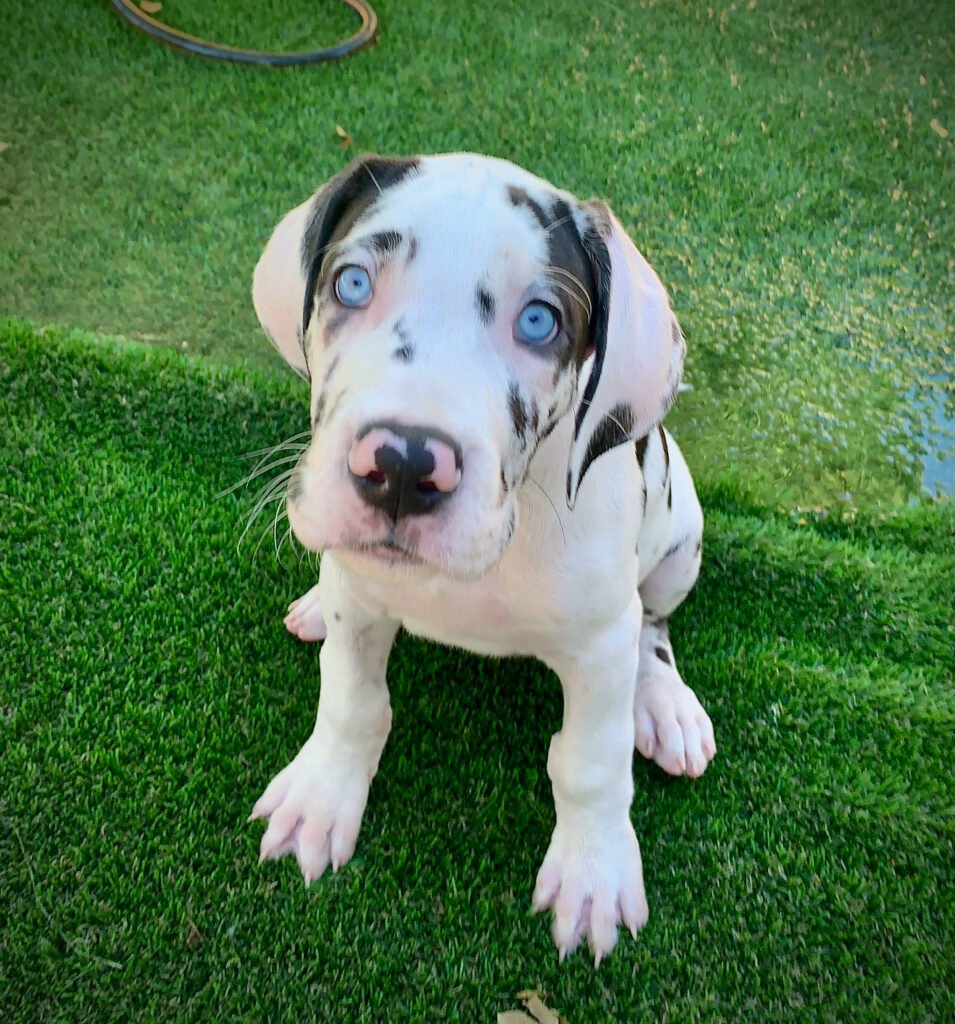
Harley
Great Dane Growth Chart (Birth to 24 Months)
The information on this page shares real Great Dane growth charts. All of the tracked weights are from one Great Dane litter through 8 weeks, plus extended growth tracking for two of my pups (Boo & Harley) up to 24 months.
Why track Great Dane puppy weight?
The first weeks with giant-breed puppies move fast. From the moment puppies are born, each one should be identified and weighed regularly to make sure they’re growing steadily and keeping pace.
In large litters, some puppies can look nearly identical, and not every nursing position produces the same amount of milk. If a puppy doesn’t consistently latch onto a productive spot, weight gain can fall behind quickly. Tracking progress helps you catch small issues early, before they become big problems.
For this litter, puppies were compared week to week, and when needed, milk replacer was used to support both mom and pups, especially when demand was high. Around three weeks, softened puppy food was gradually introduced to help the transition from nursing.
Birth to 8 Weeks
| Puppy ID | Birth | ~2 Weeks | ~4 Weeks | ~6 Weeks | ~8 Weeks |
|---|---|---|---|---|---|
| Red | 21.2 oz | 36.6 oz | 60.0 oz | 79.1 oz | Left Home (8 wks) |
| Pink | 21.5 oz | 36.2 oz | 61.6 oz | 71.6 oz | Left Home (8 wks) |
| Yellow | 18.5 oz | 34.7 oz | 53.8 oz | 60.7 oz | Left Home (8 wks) |
| Black | 20.0 oz | 43.0 oz | 57.4 oz | 66.5 oz | Left Home (8 wks) |
| Purple | 21.3 oz | 31.9 oz | 53.7 oz | 59.9 oz | Left Home (8 wks) |
| Beige | 21.7 oz | 36.8 oz | 58.9 oz | 68.7 oz | Left Home (8 wks) |
| Deep Blue | 18.0 oz | 33.2 oz | 55.4 oz | 64.2 oz | Left Home (8 wks) |
| Orange | 18.6 oz | 32.7 oz | 58.7 oz | 69.9 oz | Left Home (8 wks) |
| Green | 19.4 oz | 35.4 oz | 53.6 oz | 59.6 oz | Left Home (8 wks) |
| Light Blue | 20.4 oz | 30.7 oz | 51.0 oz | 58.8 oz | Left Home (8 wks) |
How to read this: These numbers show a simple snapshot at key points (birth, ~2, ~4, ~6, ~8 weeks). The full daily charting helps spot small dips early, but this summary is easier for most owners to use.
Boo & Harley Growth (2 to 24 Months)
| Dog | 2 Mos | 3 Mos | 4 Mos | 5 Mos | 6 Mos | 7 Mos | 8 Mos | 9 Mos | 10 Mos | 11 Mos | 12 Mos |
|---|---|---|---|---|---|---|---|---|---|---|---|
| Harley | 19.4 lbs | 26.8 lbs | 37 lbs | 48 lbs | 58 lbs | 65 lbs | 77 lbs | 83 lbs | 89 lbs | 90 lbs | 93 lbs |
| Boo | 16.9 lbs | 25.1 lbs | 33 lbs | 47 lbs | 60 lbs | 69 lbs | 81 lbs | 94 lbs | 102 lbs | 110 lbs | 115 lbs |
| Dog | 13 Mos | 14 Mos | 15 Mos | 16 Mos | 17 Mos | 18 Mos | 19 Mos | 20 Mos | 21 Mos | 22 Mos | 23 Mos | 24 Mos |
|---|---|---|---|---|---|---|---|---|---|---|---|---|
| Harley | 98 lbs | 103 lbs | 102 lbs | 105 lbs | ||||||||
| Boo | 132 lbs | 147 lbs | 170 lbs | 172 lbs |
Note: Blank cells simply mean the weight wasn’t recorded at that exact month. Giant-breed growth can be uneven, with spurts and plateaus.
How to use this chart (without overthinking it)
Use this page as a realistic reference point, not a scoreboard. A healthy Great Dane puppy may fall above or below these numbers and still be developing normally. For additional context, Harley is a female and naturally on the smaller side, including below-average height for the breed. Boo is a male who was the smallest puppy in the litter and developed more slowly early on. During birth he required brief assistance to begin breathing, but he ultimately caught up well. Today, Boo stands about 29 inches tall, which is within the normal range for Great Danes, though he currently carries excess weight that we are actively working to manage. His growth pattern is a good reminder that individual dogs can vary widely and still mature into healthy adults.
What matters most is steady progress, good body condition, and a puppy that’s energetic, eating well, and developing normally. If your puppy’s weight stalls, drops, or consistently falls behind littermates or age expectations, talk with your veterinarian.